Feature
Meet the Makers: Stephen Cassilo, Glyph
Stephen Cassilo turned a high school doodle into a popular daily word game where the puzzle is based on letter shapes.
 By Craig Dugas · ·9 min read
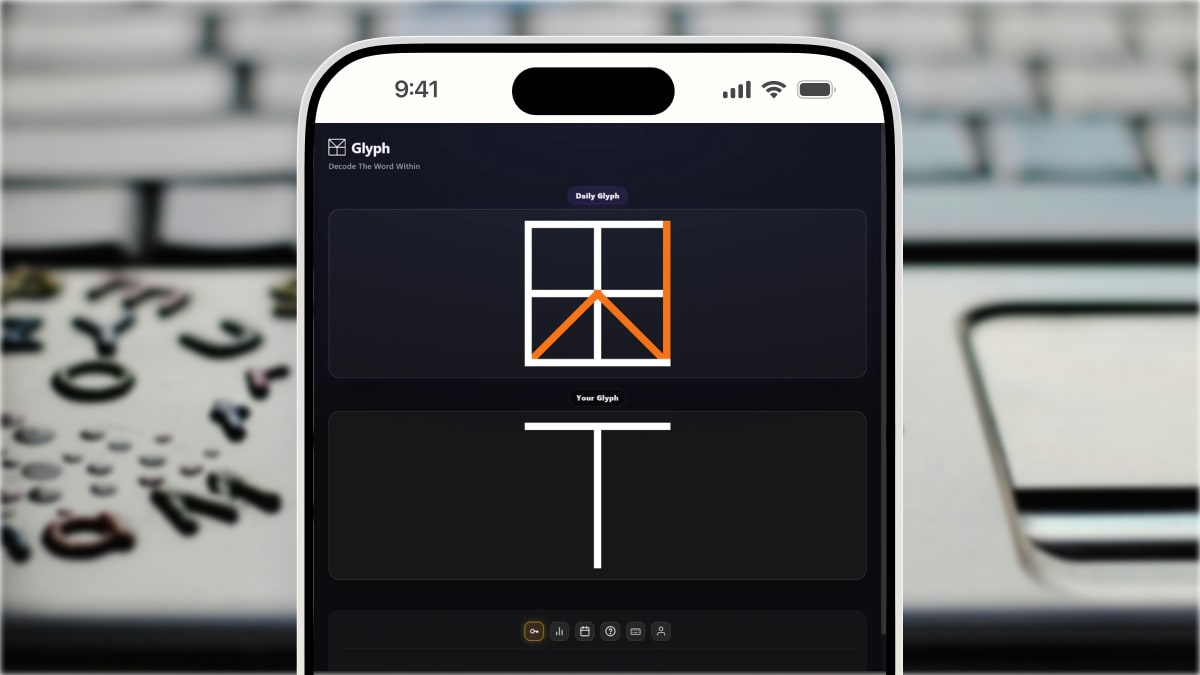
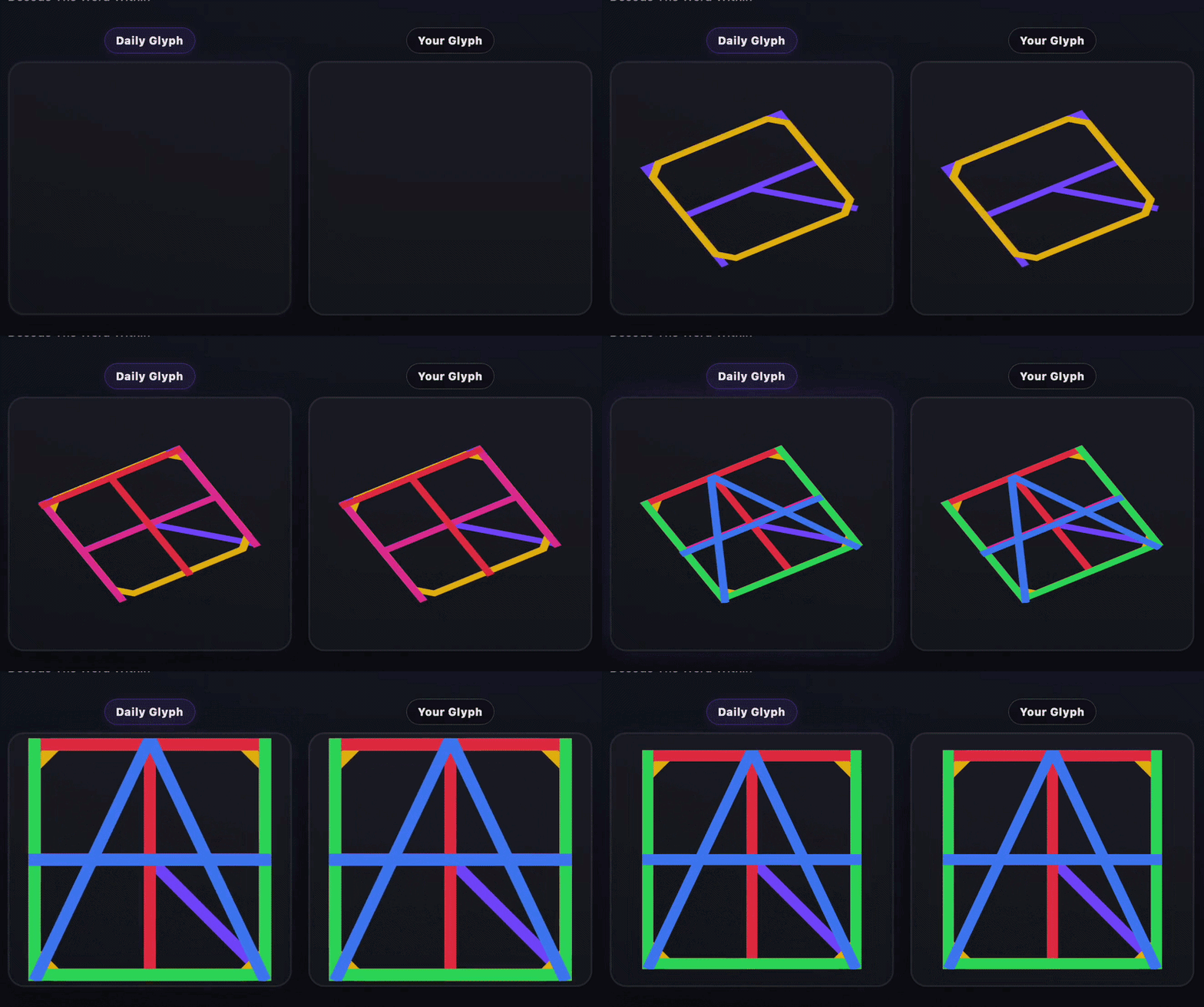
Most daily word games ask you to simply find the word. Glyph hands you a stack of letters and asks you to reverse-engineer the answer that’s right in front of you into the daily target word.
The idea is almost twenty years old. Stephen Cassilo first stacked overlapping letters on graph paper in a 2007 geometry class, hiding words from the friends next to him, then set it down for the better part of a decade and a half. When he came back to it looking for something to tinker with, the format Wordle made ubiquitous turned out to be exactly the mold his old doodle fit into. He built an MVP fast, watched early playtesters respond, and went all in.
Glyph is that doodle, modernized. Each day’s puzzle is a single dense glyph built from overlapping letterforms, and your job is to decode the word hidden inside. Cassilo drew a custom SVG alphabet for it, works in plain HTML, CSS, and JavaScript with no framework, and ships to web, iOS, and Android solo, around a day job as a product manager. The game went from roughly 500 daily players in late January to 10,000 by mid-April, and crossed a million total plays along the way.
We asked Stephen about the alphabet he had to invent, the letter he can’t stand, and why he spent more time on the difficulty curve than on going viral.
In conversation with Stephen
You’ve told the 2007 origin story: geometry class, graph paper, stacking letters to hide words from your friends. What made you finally build it nineteen years later? Was there a specific moment, or did it just nag at you long enough?
I don’t think there was a specific moment. I admittedly even forgot about it for probably 10 to 15 years or so. I just wanted to tinker with something and I remembered this concept. The real “aha” moment was when I realized it might fit into the daily game mold that’s become so ubiquitous since Wordle.
So I went off running with it and spun up an MVP very quickly, and the response from my early playtesters was positive enough for me to go all in.
Glyph lives or dies on the letterforms. They have to be visually distinct enough to decode but ambiguous enough to be a puzzle. You built a custom SVG font for the game and redesigned the R and the K mid-flight after launch. Walk us through the design constraints of a “Glyph alphabet.” What makes a good Glyph letter versus a bad one?
Locking in the alphabet was definitely the hardest aspect to get right. They are not a 1:1 with the letters I used back in high school playing around with this concept. I was basically working around: the letters sharing enough geometry for them to blend, the letters being unique enough to make the glyphs feel unique day to day, and figuring this out based on player feedback but not changing TOO much after release, because alphabet knowledge is a core skill that makes the game work.
You also need to balance the uniqueness of a letter with how common it is in the English language. R and K changed to overlap more with N, W, M, Z, X, and Y, all letters with diagonal segments, because they were showing up often enough and giving away too much information.
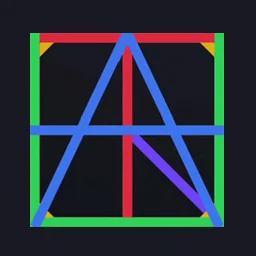
The extended crossbar of the A both provides an obvious letter and muddies the water for the rest of the puzzle.
What’s the hardest letter in the alphabet to make work in Glyph, and what’s the most satisfying one?
Most satisfying is A. You can instantly recognize there’s an A in the glyph, which is great because it gives players a thread to pull on, but it also serves another purpose. The extended crossbar of the A adds ambiguity to the rest of the puzzle because it overlaps with E, H, P, S, and F. It both provides an obvious letter and muddies the water for the rest of the puzzle.
V is the worst letter. I hate the V. It adds nothing to the puzzle, it’s basically a free letter. But I couldn’t come up with another way to draw it, and it was uncommon enough that I eventually moved on.
You shipped web, iOS, Android, an archive, post-game stats, randomized difficulty, and Guilds in about four months as a solo founder. Walk us through your stack and your workflow. What tools, traditional, AI, or otherwise, are doing the most heavy lifting, and what’s the one decision that’s saved you the most time?
The one decision that saved me the most time was just making the apps a webview. It’s a shell that loads glyph.today. I really just wanted the apps out there for the benefits a homescreen presence and push notifications for daily games.
The game itself is plain HTML, CSS, and JS with no framework, using MongoDB as the backend for accounts, guilds, and so on. (I have to mention them, as my employer!)
Claude Code has been an incredible tool for helping me bring this to life with the limited time I have to dedicate to it, between family, work, and other interests. I’ve worked in software development for nine years now as a product manager, so I have a great grasp on the iterative process you need to take to build a successful product, as well as the signals in the data to look for to steer the product and using Claude to speed up the iteration process has been awesome.
You wrote on LinkedIn that “retention > virality” and that you spent more time on the Monday-to-Sunday difficulty curve and streak mechanics than on shareability. That cuts against most launch playbooks. How do you actually think about the difficulty curve week over week, and what did you change after launch when you saw real data?
I actually changed the difficulty curve entirely! I saw in the data that people fell off on harder days, so I reframed how difficulty works. The words are bucketed into easy, medium, and hard based on shared geometry, and they’re randomly seeded throughout the week. It’s weighted so most words are medium, with easy and hard sprinkled in. The random nature keeps the game feeling fresh and removes the expectation.
I tried posting on Reddit, Hacker News, Twitter, and Bluesky and really saw no traction at all.
From your own posts: about 500 daily players in late January, 3,500 in mid-February, 10,000 by mid-April. What actually moved the needle? And what did you try that didn’t work?
Short-form video was what eventually took off. Between TikTok and Instagram Reels, the Glyph accounts have generated well over 15 million views. Just posting videos of me playing the game, with no explanation, seemed to draw something in. I think the visual nature of Glyph helped a lot there. I tried posting on Reddit, Hacker News, Twitter, and Bluesky and really saw no traction at all.
The iOS app launched in March, Android followed. How does player behavior differ between web and app, and which one are you optimizing for now?
The apps are much stickier. 90% of app players play every single day. Web players still have strong retention numbers, but they drop in and out throughout the week.
It’s the same game on the backend, so I’m just focused on improving the core game at this point.
Wordle made the modern daily word puzzle a format. Connections proved there was room for another mechanic. What do you think the next breakout daily word game looks like, and is Glyph it, or is it something nobody’s built yet?
I hope it’s Glyph! I honestly think it hasn’t been built yet. Wordle broke out because it was accessible for all types of players, and the sharing mechanic was unique and primed for virality. We need something that introduces the next “emoji share” moment. Something that makes people say “what’s that,” and when they land on it they “get it” within a couple of seconds.
You posted that “as gamers, you should be rooting for every project to succeed.” That same energy shows up in how you talk about the daily games space. If you were curating an “if you like Glyph, try these” shelf, what’s on it, and why those specifically?
WordWavr. I love this game and consider it Glyph’s unofficial cousin. Words represented as abstract images, with unique feedback loops!
Bracket City. Similar feeling of “untangling a knot” that Glyph provides.
Cryptle. Provides that “decoding” feeling.
You’ve publicly pitched Glyph for a single-brand sponsorship: 10K daily players, a million minutes a month of playtime, 15 million social views, no ads. What does the next year of Glyph look like if that sponsor shows up, and what does it look like if you keep going solo?
It’s a nice-to-have for sure. I don’t want to add ads to the game, but a single sponsor tastefully layered in would help cover some of the operating costs. That said, Glyph isn’t going anywhere with or without a sponsor. We just hit a million plays since launch in late January. I couldn’t take that away from people!
Cassilo’s base concept for Glyph, the idea that you read it before you solve it has that timeless feel to it. The A you spot instantly and the V he can’t stand are two ends of the same problem, which is that a letter’s job in this game isn’t only to be a letter. It’s to be a shape that helps or misleads. That’s also why short-form video did what Reddit threads couldn’t. A game whose appeal is largely visual doesn’t need a caption. You watch someone decode the glyph, and within a couple of seconds, you either get it or you want to.
If you’ve got five minutes today, give it a play. Then watch for the A.